


Welcome to the PLAYGROUND.
In the West, we bury our ghosts and pretend they stay buried.
In Japan, the dead linger closer to the surface.
Shrines are not always monuments of devotion. Some are cages. Tonight’s tale takes inspiration from one of Japan’s most feared vengeful spirits — Taira no Masakado, the rebel whose severed head refused to rest.
He died in pieces, too. And some believe he still exacts his vengeance on the land.
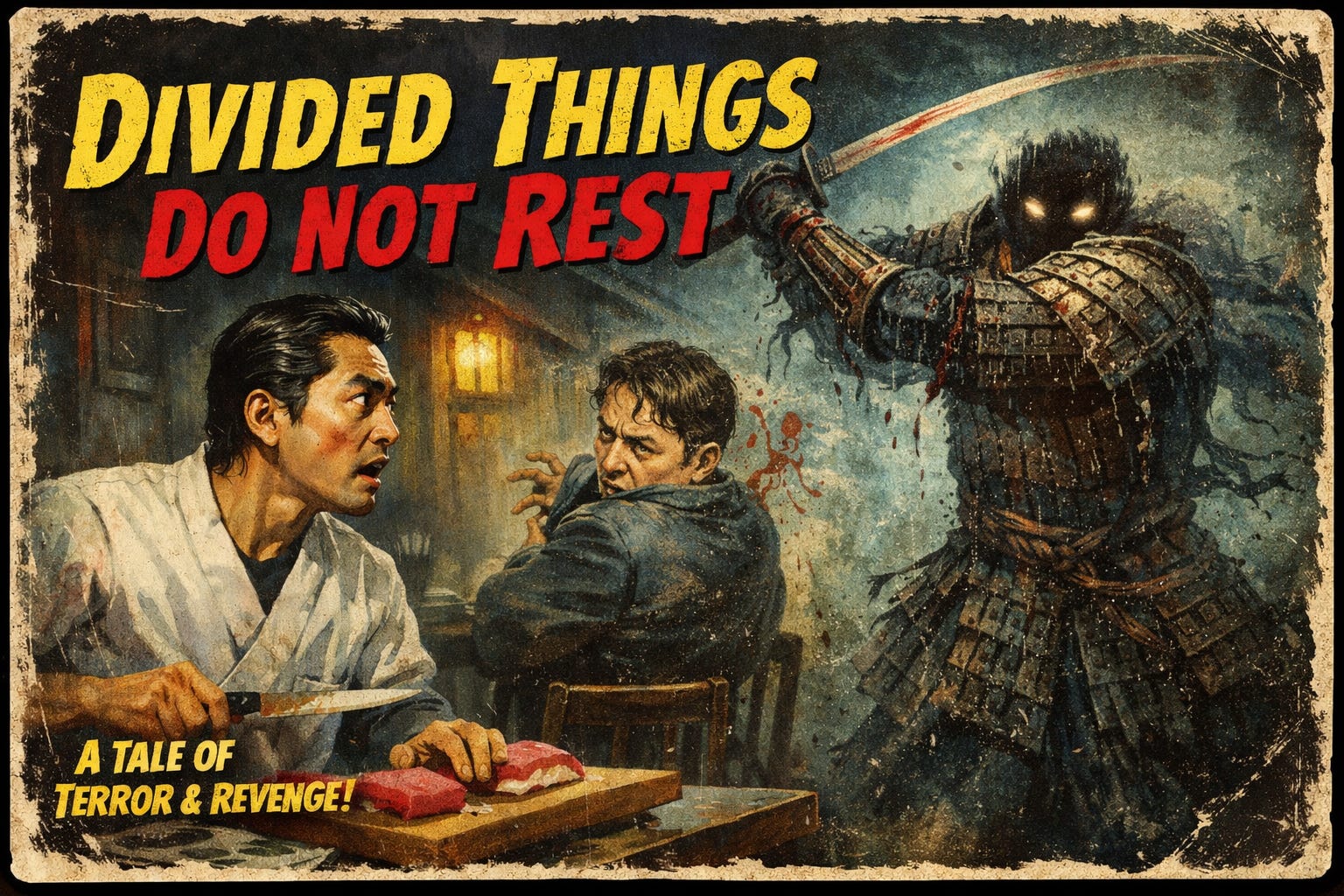
At his feet, rice and the contents of a shattered glass bled out across the floor. Falling when the chef lurched back, they cast their destruction wide as the moon. “I.. I.. can’t help you! Just get out. Leave. Now!” His voice cracked through the narrow sushi bar, barely big enough to fit a counter and kitchen. But the customer didn’t move. Teeth showed, but ground together. Slow and deliberate. He remained at his stool with death fixed upon his face. No more than thirty minutes earlier, the sliding door had peeled open, and he walked in from the noon light, cutting short the customary Irasshaimase — with a single word.
“Beer.”
The order snapped at the bar, mirroring the door’s clatter behind him. Without waiting to be invited, he sat down at the counter. Round one drained while the foam still settled, and a finger lifted for another before it was completely empty. No eye contact. No thanks. The grip of the glass was wrong, though — almost too tight. And the chef couldn’t help noticing how his throat worked through each gulp, requiring strained effort. More beer went down. It was desperate for midday, as if alcohol could stitch back something unraveling inside. But the chef forced himself not to stare, just hoping a quick meal would satisfy. After all, the rule here was concern yourself with your craft, not troubled men. They often accompanied complications. With drunks, he could drag them into a taxi before the dinner rush, if no one passed out before paying. But people carrying the kind of heaviness he was were never alright. The air was off in here today. The chef resigned himself to inspecting knives instead. Steel reflecting his own face back distracted the chef from wondering what else could have walked in with the man.
“Got a discount on tuna today.” The chef said, breaking the silence in two. “680 yen, if you’re interested.” The customer waved with what passed for approval, and the chef turned his back to work on the meal. He reached for a lacquer bowl, but not before catching the customer’s hand scratching at the counter wood.
“I just found out,” he announced from the foam of his drink, “my employer from six months back… well, he’s dead.”
After making an initial cut, passing through flesh, the chef replied, “Sorry to hear that.”
“You’re not going to believe me.” A swallow, or a moment to find courage to say what came next. “It wasn’t normal… They found him in pieces.” The chef’s hand hesitated on the knife — only for a moment — before continuing on a clean geometry through sliced fish.
Pieces.
Hadn’t he heard of such a death four nights ago? A bank manager, Suzuki Mitsuru, was discovered mutilated in the sub-basement of his home apartment. Grisly details never stayed buried in a neighborhood like this; they tended to spread — whispered between locals, carried in the folds of receipts and small talk.
The customer went on, “I’m not from around here. If I were, I probably wouldn’t have accepted his demolition job over at a near-by shrine. Or at least taken the advice not to. Do you know the Mizu-Kage shrine? Suzuki wanted it gone so he could build a new office.”
As the chef aligned the tuna carefully, correcting a slight misplacement so that it formed a continuous shape, a memory struck him. That shrine. At that name, a fragmented puzzle settled into place in the chef’s mind. He knew all about that place. The Mizu-Kage shrine was never grand. Almost forgotten. No painted beams or sweeping tiled roof. Just a weather-darkened torii leaning toward the riverbank, as if listening. Moss crept thick over the stone steps, swallowing edges so it felt like stepping onto something still alive. Even in summer, the air around it remained cool. The river there did not rush like elsewhere; instead, it eddied against the bend as though unwilling to move on. Villagers once left small cups of sake beneath the eaves. No one remembered why offerings were set there, only stories of misfortune if they ever stopped.
“At first it was nothing,” the customer muttered. “Old wood. Rot. The usual.” His fingers tightened around the glass. “But the excavator stalled three times that first week. Wouldn’t catch. Its driver swore the ground felt soft beneath the foundations, like we were digging into wet cloth instead of earth.”
He swallowed.
“When a support beam gave way, water poured up with it. Not groundwater — it smelled wrong. Like it had been trapped too long. One of the workers became convinced of knocking from below. We told him it was pipes. Of course, there were no pipes.” He let out something like a laugh, but it failed halfway. “By the second week, nobody stayed past sunset. That’s when work stopped, and I was sent home.”
The chef remained silent in the wake of his customer’s story. The meal demanded too much concentration. He also dared not respond to the young man’s story. On the steady press of his thumbs, he kept his eyes lowered.
“Please, if you know anything,” the man continued, voice tightening into a whispered plea. “Whatever tore Suzuki-san apart…. I’m sure I’m next.
Something followed me home,” His gaze drifted somewhere beyond the door behind him. “I woke up two nights ago, and the tatami under my futon was wet. Not soaked. Just… wet. My windows were closed. The ceiling dry. But the room smelled like river mud.”
He wiped at his sleeve unconsciously. “And in the mirror…” He stopped. His jaw tightened. “Sometimes I look taller. Like something stands behind me, and I am the shadow.”The beer trembled in his hand. “I’m desperate. There are things in the night. Horrific things, like there’s a darkness stalking me.”
After drawing a breath in, the chef spoke quietly. “There was a samurai once. Ashikaga no Sadamitsu.”
The name seemed to cool the air.
The chef’s knife moved cleanly through tuna, separating flesh with careful precision. “Back during the Heian Era, he rose in rebellion. Waged war on the court in Kyoto, even promising to kill the emperor. And for that, they cut him into five pieces and sent them to the far reaches of the country as punishment. It’s believed a spirit divided cannot find peace.” The customer’s breathing had grown shallow now, and the beer in his glass rocked form side to side.
“They say when Sadamitsu’s body was divided,” the chef continued, “each piece was sent in a crate, sealed with the imperial crest. The crates traveled by ox cart, guarded by men who refused to look inside. But the head…” The blade paused only a fraction before pressing into the next cut. “The river near here floods without warning. The cart seemed to be passing at the wrong time, and it overturned. The crate split.”
He pressed rice between his palms.
“The head lay in the current for three days. Eyes open, seething with rage. Fish would not touch it.” A thin slice fell into place. “When villagers tried to retrieve it, the rope snapped twice. Then, when nothing could be done, they begged their lord to bury it. To enshrine it, anything. A spirit that dies in pieces does not rest. It waits and curses the land.” A drop of water struck the counter. The chef realized it was not water but condensation running from the customer’s sleeve. He had not noticed how wet the man smelled. Like stagnant river silt. Like something long submerged.
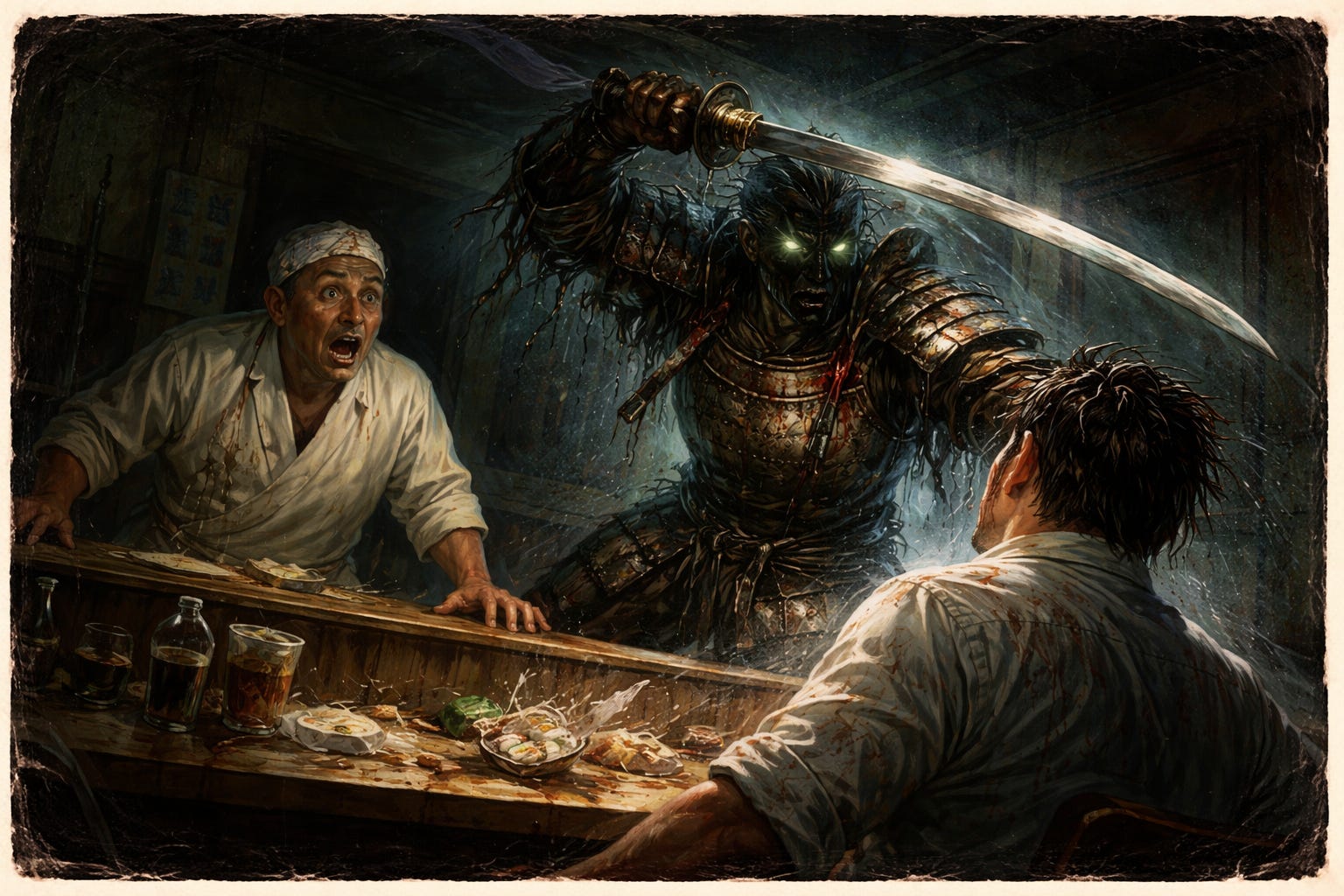
“And your bank manager thought he could disturb a demon like that without repercussions….” The chef chuckled as he placed the finishing touches on the meal. “Well, it’s only a story. I’m sure you’ll be ok. Here is your sushi — “ He finally raised his eyes to the counter. The customer’s face had contorted with pale, lips parted, pupils blown wide — but it was not the man that emptied the air from the room. Behind him stood a figure in fractured armor, plates bound with river-dark cords. Its neck ended in a ragged seam of shadow, yet its eyes — suspended in nothing — burned with hatred. Water streamed from its cuirass, pooling without sound on the floor that remained dry. The apparition leaned forward, sword raised above its head, ready to strike.
Sushi slipped from the chef’s hand and struck the floor with a flat crack. “If disturbed,” he finished, voice barely audible, “it takes what it is owed.”
The customer did not need to turn around.
Outside, the street flowed on, indifferent as a river.
.
.
Love this tale! The soul without peace is a dangerous presence.