


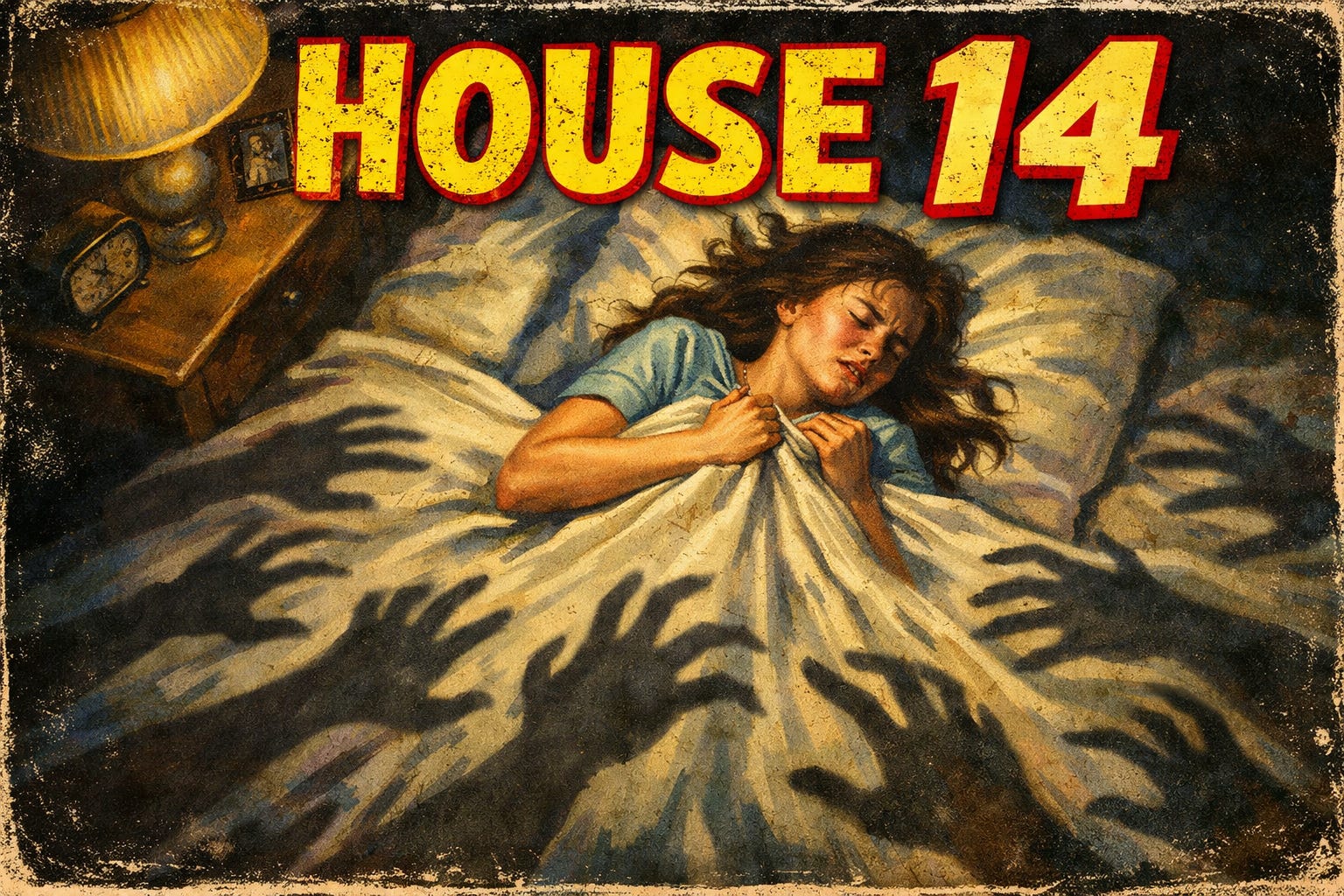
In the years following the haunting at West Street’s house 14, normalcy slowly, cautiously, returned the way dust settles after a storm. Eventually, days flourished following the rhythm of the seasons. Time dulled the fear, until even Father Bromley believed whatever evil resided there had moved on. No sounds of chattering, no tappings through the walls. Jessica changed, too, though signs were mistaken for teenage maturity. The priest, more concerned with protecting spiritual peace, came to purify the home whenever he could. But visitations dropped and prayers shortened, as his services were no longer needed. He never investigated the haunting’s cause, though, stating only that some things were best left to God.
“But what about that woman?” Jessica asked after one of his purifications.
Bromley paused, as though searching for something misplaced. “Jessica, be rest assured, my child. There is no woman.” He promised to look into it, but inquiries led nowhere. Eventually, Jessica stopped asking, and learned when not to speak. She learned how to sit still for long stretches of time too, how to keep her face composed, and how to answer questions without offering anything of herself.
Only once did something disturb the priest. An open notebook was left on Jessica’s desk. On one page, barely pressed into the paper, a name had been written and then almost erased. Helen’s ghost. The word troubled him, though he could not say why. When asked, Jessica closed it with a gentle hand, brushing it off as an art project. Her voice held no curiosity, no embarrassment—only finality. He did not press further.
In four years, Father Bromley had received a request from another parish. He left West Street with the quiet certainty that whatever had gone on in the days of the house’s trouble had been either contained, forgotten, or destroyed. The family watched him leave from their lives for good, counting the seconds until his car disappeared, and understood without quite knowing how no one would come again.
Corruptions in the house did not return all at once.
Rather, they unfolded in tones. Nothing moved in the walls this time. Nothing whispered. But David now spent fewer nights at the table. Work carried him farther from West Street, and when he stayed with the family, a weariness that did not belong followed him. Conversations shortened. Doors closed more often. Jessica watched her mother speaking optimistically at first, filling silence with unanswered questions. He sat with his coat still on, answering only in half-sentences, eyes drifting to the clock, wishing to be anywhere else. When they began to pass each other in their hallway like strangers, Jessica chose to keep her problems to herself. Recurring nightmares began haunting her nights, and an old woman’s voice wafted through her bedroom.
The truth came without ceremony. Her mother finally confronted her father in the kitchen one evening, hands trembling against the counter. There was shouting, fighting. Jessica didn’t look up from her plate, unconsciously counting the seconds between raised voices. She was alone in her room when the clashing of bedrock finally broke their family.
David left two weeks later. When he finally went, there was no goodbye, no slammed doors, no final argument. Just the soft click of a lock. By seventeen, Jessica barely kept her head above water. Her father’s absence shaped the house—twisting doorways, hollowing out rooms into echoing shells. Some days she didn’t leave her bedroom. On others, she moved with a frantic tenderness that left Jessica unsure where to place her hands, her voice, herself. The nightmares only grew.
As time marched on Jessica failed an exam, then another, then more— enough for red warnings to blossom on her papers. They were folded into her bag and forgotten about, creased and softened by weeks of being carried. No one asked about them, anyway. At dinner, talk focused on a neighbor’s new car, or rising grocery costs, instead. Jessica nodded at the right moments. She tried to explain the feeling to a school counselor—how it seemed as though a darkness followed her, how she felt thinning, as if an essential part of her had been lost. The woman smiled kindly and asked if she was getting enough sleep. Jessica replied yes. She learned the correct answers. Nothing was written down. No follow-up came.
Helen’s ghost no longer needed to scream from the folds in reality. She did not claw at walls or chatter from corners. The demon only waited. In recent dreams, Jessica stood in her bedroom while the air grew heavy, waiting for the old woman behind her—close enough that breath could be felt against her neck.
You are mine, the cruel voice would say.
Jessica fought to stay awake in the final days, still here, but only in fragments. She internalized the geography of the ceiling, the exact number of cracks above her bed. She learned how to stay away from her mother’s drunken breathing in the adjacent room, slow and uneven, as if her crying were a warning. And the house frightened her more, refusing to release her. Then, at her lowest, exhaustion betrayed her. She woke to the darkness, sitting upright, hands folded in her lap. The room had changed—no shadows moving, no sound in the walls. Helen’s ghost, the demon of House 14, stood at the foot of the bed, in a shape thin and indistinct, like a figure reflected in dark glass.
“S.. You are…” Jessica replied, trailing off.
“Helen. Yes, my child.” Past the entity, to the doorway where light from the hall should have been, there was none. The house felt foreign, as though it had already decided not to interfere. “Your father is gone,” it continued. “And, your mother is disappearing as we speak, but I never left you, my child. I did everything I promised when we met.” The woman stepped closer. Not touching. Never touching. Jessica closed her eyes. For a moment, flashes of the house as it had once been came and danced over her vision: voices overlapping, the smell of food in the kitchen, her mother’s laughter drifting down the hall. She could not remember the sound of it clearly anymore. Only the shadow it had left behind.
“I don’t want to be here,” she whispered.
“Then don’t.”
The woman did not smile. She did not need to. Without another word, Jessica felt the void step into her, like needles pressing into her skin. No one was there to witness pupils clouding jet black, or stop an evil coursing from her fingertips, uncurling defenses. Years of watching from the sidelines, of containing, of pretending that survival meant living, collapsed inward. She felt the world recede, then nothing at all.
And number 14 remained silent.
Demons within and outside...
Well done! Very nice slow burn.