


Two years ago, I worked in a warehouse on a grim industrial estate outside London. The sort of shit hole where time congeals, so you end up dragging yourself from shift to shift. You know the ones, unload containers here, stack crates there. Grunt work from 9 to 5. As cranes screeched overhead and forklifts whined nonstop, we’re forced to sweat until whatever trucking company pulled in to collect. A place like that dulls in small, efficient increments, but it ain’t a problem when you’re young. You’ll do anything for money, and I was no different. At that time, I had my eyes on a new motorbike. Never did buy it, though, not after that night.
It started with my dumb friend. He told me about a side job he had going. Ridiculous money, he chuckled, for such an easy job, and all he had to do was burn things. Household goods, old junk that needed “disappearing.” Once I listened, I was hooked. The only catch was it needed to be done out in the countryside. Unauthorized fires were illegal, of course, but anyone interested would be more than compensated for the risk.
So, I jumped at the chance. I mean, if some guy offered to pay you for burning whatever, what would you do? My friend told me his role was simple. We’d be split into two groups. One for burning what was unloaded off a parked truck. He always stood with the second group, by the roadside, and kept his eyes peeled for cars. If headlights appeared on the road, they’d shout, allowing time to smother the flames until it was safe. Truckers didn’t care, but normal people did. Of course, if the police came, it was over.
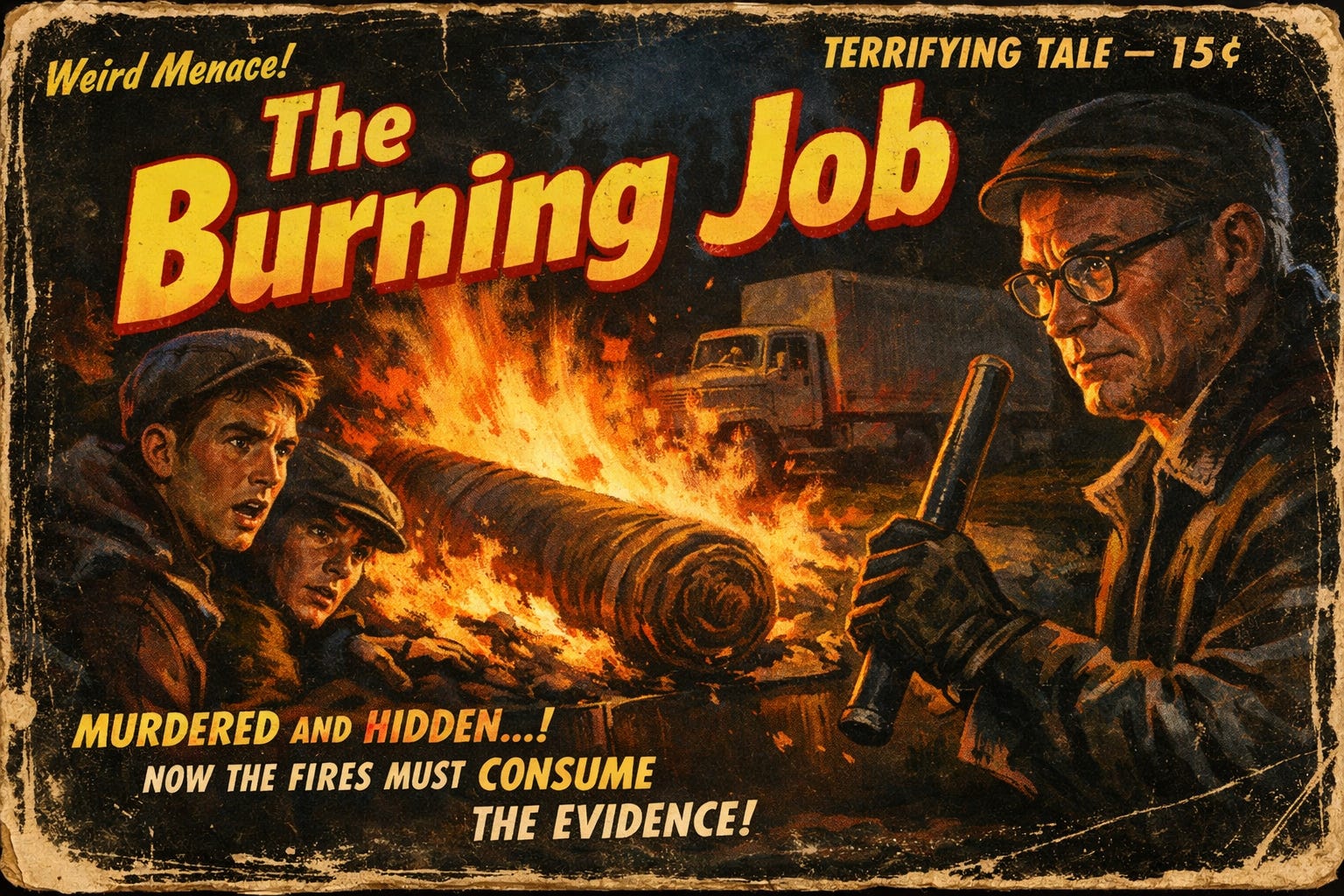
We met at the warehouse after ten one night, because it was better to work at night. The other eight with us were teenagers. All boys pretending to be men — track suits, cigarettes, too much bravado. Not built for real labour. There was one older man, though. Slim. Glasses. Neat jacket despite the mud. He didn’t say much, but you knew he was in charge. Everyone watched him, and in return, he watched everything.
By midnight, we were out of London, driving north, taking so many backroads that I was already lost. Proper dark. No streetlights. Just the rustling of trees and the hum of an idle truck already waiting for us at the site. Its back was full of furniture: desks, chairs, shelves, chest of drawers. I could tell it wasn’t from one owner either— that much was obvious. When we were lined up, the foreman walked to each of us and handed half our payment up front. My friend was loving this. As soon as I saw him grin, the anxiety seemed to fade. Sheets of paper were handed out, too. More like typed lists. “Read carefully,” he said. “Make sure everything’s gone by dawn.”
I still remember some of it. The precision felt too excessive for rubbish.
A black chest of drawers, six compartments.
Carpet.
A three-panel mirror, marked.
Carpet.
Brown chest of drawers, three small drawers over two large.
Carpet (small).
Carpet.
Then we started. “Remember what you have to do, lads, get to work,” the foreman shouted. I doused a few chairs in petrol to get the fire going. The odd thing was that all the carpets were to be packed onto the fire, then more furniture was piled on top of them, making them burn in the center. This instruction was ground into us by the foreman. At first, it was almost festive — lads talking, kicking ash, the man in glasses scrolling through his phone like he was supervising a garden party. I got chatting with another guy hauling a table with me. It turned out that no one knew each other. After more small talk, he asked what I’d spend the money on, but I wasn’t dumb enough to let too many details slip, so my answers were as vague as possible. He smiled without warmth.
Someone asked over my shoulder, where the furniture came from, and the foreman paused long enough for the night to feel thinner. “Local client of ours, you know. Wants it gone.” So that’s where the stuff came from, but what was the big deal about burning it? Couldn’t he get more money selling it? After he told us this, the foreman turned a cold, especially towards the guy asking him. Then: “Just get it done.” That was all, and he wandered off. His attitude told us no more answers.
As the night wore on, flames grew higher. The first carpet was heavier than it looked. Rolled tight, bound with tape. It took four of us to lift the damn thing. I remember thinking how awkwardly it was weighted, as if the centre sagged differently from the ends. We heaved it onto the fire.
The flames climbed greedily.
By the time we returned for the remaining carpets, the lookouts by the roadside were growing wary and restless. One of them hissed that a car was coming. Headlights flickered through trees in the distance.
“Police?” the man in glasses snapped. Before we started the job, we were told if it wasn’t the police, the next worst thing would be a civilian car. Your run-of-the-mill family car. Truckers don’t care if they see a fire; they have a job to do, and they can’t stop to report stuff. But family cars were bad news.
“Don’t know.”
“Doesn’t matter. Move.”
It got the men freaked out, and we scattered into the treeline, not far away. The fire was beaten down with shovels and dirt, reduced to a smoulder. From where I stood between two pines, I could see the truck bed lit faintly by embers — the last of the rolled carpets lying there. I was staring at the truck when it happened. One of the carpets moved, I’m not kidding. I saw with my own eyes a slow tightening. A subtle wriggle, as though something inside had shifted against constraint.
For a second, I thought my eyes were playing tricks in the firelight. Then it happened again — an unmistakable, desperate adjustment. My throat closed. The man in glasses noticed it too. I know he did. His jaw clenched. He swore under his breath, not loudly — irritated, almost inconvenienced. When the headlights finally disappeared, he didn’t say anything about what we’d seen. He simply pointed.
“Mirror next.”
I gritted my teeth, and was about to go over to the carpets when a firm hand landed on my shoulder.
“Don’t!” It was the guy who talked with me before.
“But,” I cried.
But he shook his head. “No, just don’t. It’s not worth getting involved.”
My heart sank as I carried the three-panel mirror to the fire and threw it in. The glass burst with a sharp crack. In the shards, I caught a glimpse of the foreman walking to the truck. He had picked up a metal rod. There was no ceremony. No hesitation. He drove it down into the centre of the rolled carpet with a force that jolted his shoulders. Once. Twice. A third time. A sound came out — not a scream. Not quite. Something trapped and muffled. The others pretended not to hear. Then he nodded.
“Get it in.”
We lifted it again. It was heavier now. Or maybe I was. The fire took a long time with that one. We burned four carpets that night. I never asked questions. None of us did. The lists were checked. Every item accounted for. The man in glasses collected the remaining cash from his coat pocket and paid us with clinical precision.
I didn’t sleep when I got home. For weeks afterward, the smell of smoke clung to me, even after washing. Sometimes I wake up convinced I can hear something shifting inside rolled fabric. And, I never spent the money, either. It sits in my savings account with the rest, untouched. I tell myself it’s just currency, or numbers on a screen. A month after I quit, I ran into my friend outside the warehouse. He was still doing that job now and then, still bragging about how easy the money was.
“And how many carpets do they burn out in the country?” I asked him.
He shrugged.“I dunno. There’s always a few rolled up in the truck.”
I nodded like it meant nothing. I couldn’t tell him the truth. I didn’t fancy being the next bloke rolled up and burning in the courtyside.
A month after I quit, I ran into my friend. He still does the job now and then. Still gloating about how much money he gets.
“And, how many carpets do they burn out in the country?”
“I dunno, there’s a few rolled up in the truck now and then. Why?”
I’ve never told him what I think of that job, can’t. I just hope all that’s inside those carpets is woven fabric and string.
Man! This was a rough tale. it begs for a longer story, but at the same time the horror is in speculating on what's on those carpets.