


The colossus never knew the sky, but stretched towards it.
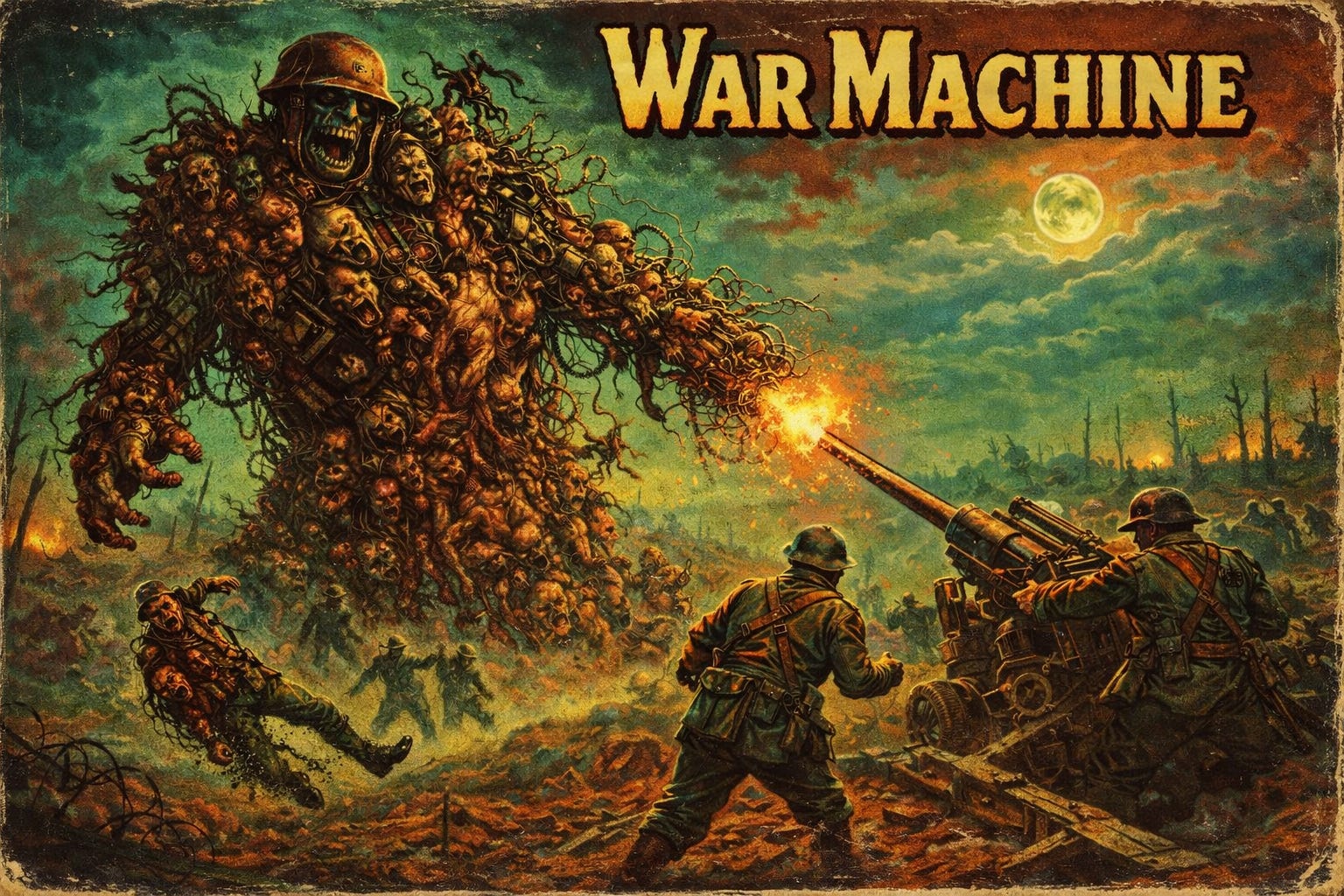
Blackened earth was its womb, ground into browns and crimson. Groaning among human remains, the corpse God swelled with each mangled soldier it claimed. From the mud and shit flesh was bound to metal, bone to chaos, and as if drawn to our despair the stalking mass took its first steps through war’s wasteland. We watched the inevitable horror wander closer. Our shellfire broke over its skin like raindrops on stone, useless, it could not be stopped. By the time the chorus of bodies tore open our defenses, it was magnificent. We felt our flanks buckle as soon as it charged like one agonized army, crushing infantry into its body.
The ground trembled.
Our men screamed as they were taken, lifted from their positions, and fused with disembodied limbs flailing along its skin. One man emptied his pistol into the thing until he was consumed, his face vanishing into its writhing chest, head first. At some point in the chaos, Captain Philips aimed his cannon and fired upon the horror. Artillery barrages flew through the air and struck the right shoulder. For the first time, the colossus shuddered before a bloated section of human torso, machine parts, and barbed wire rained to the ground. Wherever the colossus lurched, buildings toppled and men were pounded into the Earth. Then, just as suddenly as its arrival, our intruder melted back to where it had come from, back into the war fog.
When it was safe, we rushed to what had been its arm, to what was left of friends. It was twitching and jerking, and whoever dared to look saw faces pulsing within a translucent membrane — howling, gnashing, pleading, lips trying to form words. We aided as best we could, prying men loose, but most couldn’t be saved, most were beyond human. Globs of pus and blood wept from the survivors where the colossus had begun weaving them in, and skin peeled at the slightest touch, but they did not cry. They smiled. One whispered on his way to the medics, “I felt it…bliss. I was everyone.” Another clutched his torn side like it was a sacred wound. “It loved me,” he mumbled, eyes black with awe.
Over the following week, the survivors lay awake, staring. Silence descended over the base, save for their whispered hymns. Speaking in voices no one understood, it unnerved us at first, but some began to listen. Whispers became prayers, rumors became hymns, and the men who were a part of the monster self-proclaimed themselves mad prophets. We pressed their ears to the ground, as if listening for a heartbeat beneath the soil. Others waited with hands clasped, trembling in reverence. Soon our comrades no longer spoke to each other, our minds had changed. In one room, a private from 3rd Platoon slit his palms and traced the colossal man in blood on the wall. Another covered himself in mud. And the madness seeped outward, growing through our ranks. The officers posted guards, barked commands, but their voices grew hollow. A lieutenant stood in front of a sergeant as he walked toward the barbed-wire line, grabbing his shoulder and screaming for him to return. The sergeant turned, slowly, and pressed his forehead to the other. The lieutenant just stared into the fog long after he was gone. Eventually, even they quieted, sitting with the rest of us, gazing towards a barren wasteland.
In just under two weeks, half the unit had vanished into the fog, dropping their rifles like dead skin, and others walked forward as if approaching a lover’s arms.
The rest followed.
We began to crave the colossus, prey for its return — we wanted to dissolve, to be unmade and remade. To merge something greater than ourselves. Some say it was a weapon, born from man’s death and rot. The mutated prophets, the ones who were it, told us it was older than the war — that it waited beneath the ground long before the first bullet was fired. A sleeping god disturbed by our hunger for slaughter. A hunger it would answer.
If the war was its cathedral, the colossus was our god.
We used to fear death. Now we worship it.
It came again. Without thunder, nor screams, but in a quietude that swallowed the world. The fog parted like reverent hands, and there it stood, at the edge of the base, still as a monument. The corpse colossus.
We watched from the barracks windows, from behind sandbags and fences and bent steel, watched as if waiting to be chosen. Some fell to their knees, sobbing, arms outstretched, singing to it with cracked verses, offering themselves in the hope of union. But Captain Philips was the first to approach, lighting himself on fire and screaming into the haze, flames trailing behind him like a banner. It made no move to take him. It only received. Then the base erupted in ecstasy. Men tore off their uniforms, clawed through the wire, and climbed over each other just to be devoured. We charged as one, flinging ourselves into its divinity — into the folds of flesh and wire and teeth. Into the body of our god.
We begged to be unmade.
Very nicely done, hoists a drink in your honor.
Divine horror. Eerie and skin-crawling in the best way. The fact that this came out Guerrilla Literature style, brain to page to publish, makes it even more powerful. I wonder if something so completely bizarre and brilliant would ever find its way to life if overthinking and preening got in the way? Fun and gruesome is right. Bravo.