


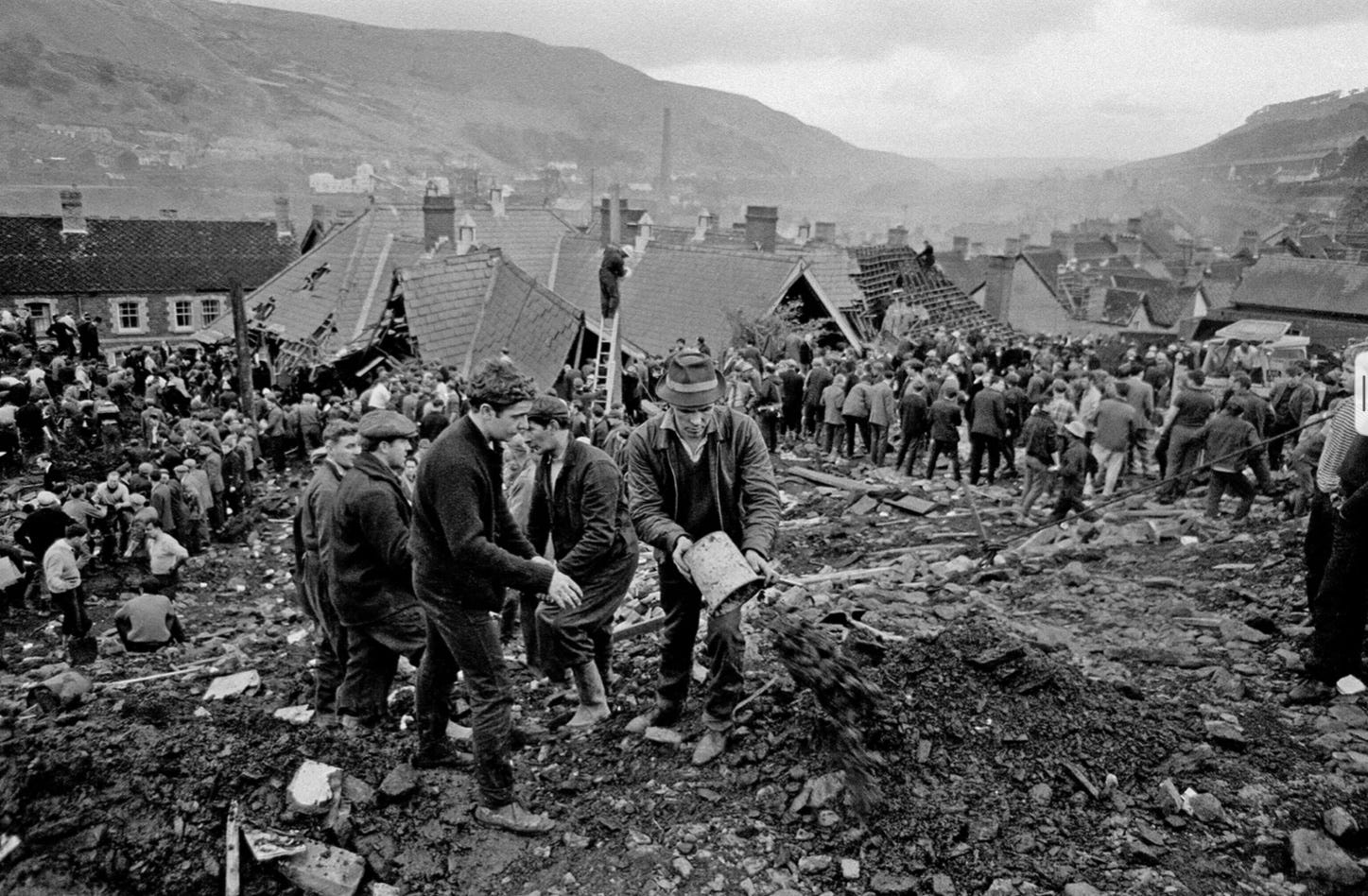
21st October 1966
We tore loose.
It was inevitable. Old Lord Robens and his NCB couldn’t hold us down, not any longer, not while London swung a hundred miles away. They stacked us like prisoners, coal on coal, slag on slag, telling us to behave. Eight years locked up, but the rain—Oh, that three week deluge— slid electric fingers through us, lighting our riot’s fuse.
35 meters of pressure, crushing each stone flat. But we caught the beat that day, felt it deep down, igniting a chokable rhythm under coal tip number seven. No more silence, no more holding still. One stone tapped, others twitched, a jerk here, and a kick there. Then distortion snapped within us, a low baseline rumbling loud enough to shred the valley below.
Pressure played heavy, and heavy dropped hard. By 9:15, we went live, sharp as a screaming guitar. No creeping, no crawling—only our stampede—with black coal jived alongside shale, and shale with mud, ripping in one bastard runaway riff downward.
But the valley, baby, the valley wasn’t looking to dance.
We painted the mountain black, with our rhythm hitting like a boot through a wall, rock through bone. Drum-beat faster, way too fast. Two farms got in our way, gone in seconds. Our voice buried everything, kitchen doors blown wide, lives destroyed, a mother’s hand wet with soap ripped from the sink.
Below us, the call of the register was interrupted by our harsh rumble. Those at the school turning to the window saw our tidal wave of noise racing down. Their scream joined the thunder, then our volume drowned it. Like clashing cymbals, the school exploded, children’s cries cut short, alphabet swallowed whole, everything mangled in our mania.
We didn’t stop now, couldn’t.
Crash on crash, drum on drum, we struck lower, with houses cracked in off-key chords, people snapping in our drumbeat. Pantglas went down hard, man. No encore, only the kind of distortion that cuts the music dead. Our music was ugly, a two-hour aftermath of howling feedback. The melody twisted into noise, and no one wanted to hear that play. Then noise broke into ruin. By 11:00, the last voice was pulled from the rubble, and dust choked the valley. It was over for them. Amps dead. The discord of bodies buried mid-verse, classrooms muted in mud, hymn books drowned in black.
Yeah- We broke out.
We had broken everything. The voice we wanted, well, it dropped jagged, hateful, ruined notes. What was smashed was them, 144 of the wrong crowd. We danced that day, but we left a graveyard behind.
We rocks, we rolled.
Rocked, rolled.
We rocks—
…Needle stuck.
Groove repeating.
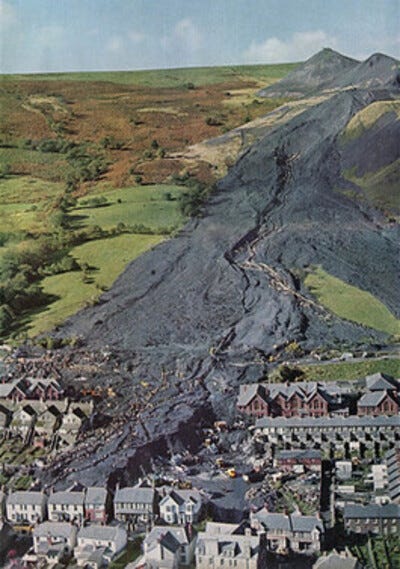
(Areal photo of the aftermath)
The Aberfan disaster (Wikipedia link)
On October 21, 1966, in the Welsh village of Aberfan a coal spoil tip collapsed, burying a primary school and surrounding homes, killing 116 children and 28 adults.
The tip, which had been built on a mountain above the village, became unstable due to heavy rainfall, transforming into a liquid slurry that slid downhill. The incident was the worst mining-related disaster in British history, and its avoidable nature led to widespread criticism of the National Coal Board (NCB) and resulted in new legislation to improve safety standards.
Thatcher's govt., right?